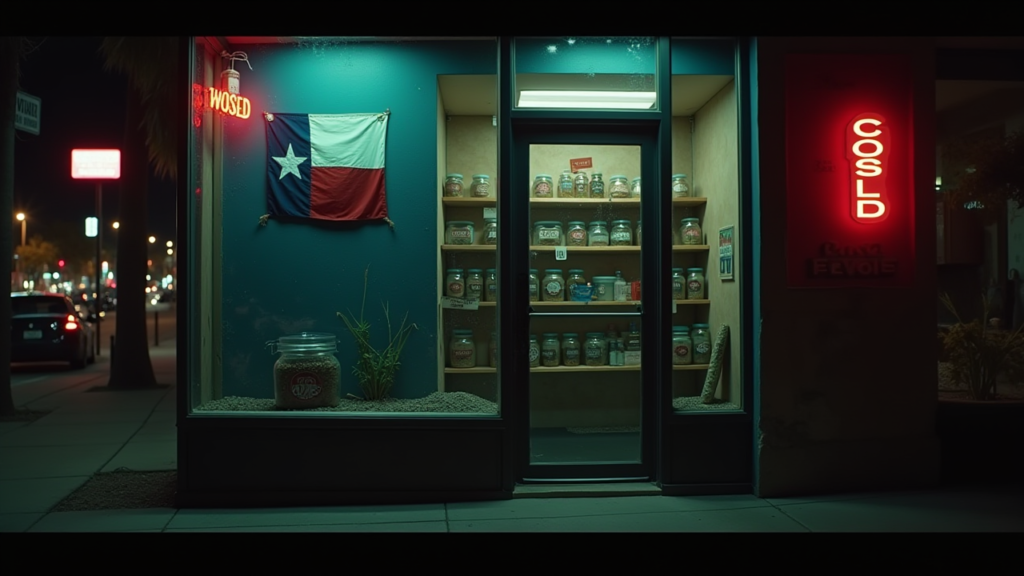
Walk into any licensed smoke shop in Dallas, Austin, or Houston on March 30, and you could have bought a quarter of THCA-dominant hemp flower over the counter. Walk into the same shop on April 1, and you could not. Texas closed the THCA loophole as of March 31, 2026, and with it closed the only legal cannabis access most Texans have ever had.
What Texas Just Banned
Texas’s new rule removes THCA flower from the legal hemp definition. The state now measures total THC including THCA, not just delta-9. Since THCA converts to delta-9 THC when heated, it was chemically indistinguishable from regular cannabis once smoked. The hemp industry built an entire market around this distinction. Texas regulators closed it overnight.
Retailers had to pull inventory. Farmers who contracted to grow THCA-heavy genetics for the Texas market are stuck with product they cannot move. Consumers who relied on legal hemp flower are back to either the illegal market or a three-state drive.
“Texas had a decision to make. They could have regulated hemp THCA the way real adult-use states regulate cannabis — age checks, potency labels, lab testing. Instead they just banned it. Now the same product moves underground, no quality control, no tax revenue, and the small licensed retailers who followed every rule get punished.” — Matt, Divine Tribe
The Chemistry: Why THCA Flower Is Cannabis
The cannabis plant doesn’t actually produce delta-9 THC. It produces THCA — tetrahydrocannabinolic acid — a slightly larger molecule with a carboxylic acid group hanging off one end. That extra acid group is the only real chemical difference between THCA and the delta-9 THC that gets you high.
In its raw, unheated form, THCA has almost no psychoactive effect. You could eat raw cannabis flower and feel nothing, because THCA doesn’t bind well to the CB1 receptors in your brain. The acid group physically prevents a proper fit.
Apply heat — a lighter, a vape coil, an oven — and THCA undergoes decarboxylation. The carboxylic acid group splits off as CO2. What remains is delta-9 THC. The conversion is not 100 percent efficient, but typical decarboxylation yields roughly 87.7 percent conversion of THCA into delta-9 THC by weight.
The reaction begins at around 220°F and accelerates from there. A lighter to flower in a bowl runs well above 900°F. A dry herb vaporizer at 380°F completes the decarb in seconds. Baking cannabis into a brownie at 240°F for 30 minutes drives the reaction to completion.
Which means: a jar of “THCA flower” with 24 percent THCA, once you light it, delivers about 21 percent delta-9 THC directly into your bloodstream. That’s stronger than most state-licensed dispensary flower.
How Your Body Actually Handles Each One
Raw THCA ingested without heat:
- Doesn’t cross the blood-brain barrier efficiently.
- Doesn’t activate CB1 receptors — no intoxication.
- Has mild anti-inflammatory and neuroprotective effects in preclinical research.
- Detectable in blood and urine, but at different marker levels than THC.
Delta-9 THC ingested or inhaled (whether originally grown as delta-9 or converted from THCA by heat):
- Crosses the blood-brain barrier quickly, especially when inhaled.
- Binds to CB1 receptors in the brain — the euphoric, analgesic, appetite-stimulating effects commonly called “the high.”
- Peak blood concentration in 3–10 minutes inhaled; 60–180 minutes oral.
- Metabolized by the liver into 11-hydroxy-THC, which is itself psychoactive and is responsible for the longer, heavier effects of edibles.
Your body responds to decarboxylated THCA identically to delta-9 THC grown as delta-9 in the first place. A drug test cannot distinguish between them — both show up as the same metabolite. The legal system cares which jar the molecule came out of. Your endocannabinoid system does not.
Why The 2018 Farm Bill Allowed This
The 2018 Farm Bill defined legal hemp by a single measurement: less than 0.3 percent delta-9 THC by dry weight. Notice what is missing — any reference to THCA.
This was not malice; it reflected the state of cannabis chemistry awareness among congressional staff at the time. Lawmakers thought they were legalizing an industrial fiber crop. They did not anticipate that farmers would breed high-THCA cannabis varietals that tested compliant on delta-9 but were chemically indistinguishable from weed once heated.
By 2021, multiple farms in Oregon, Colorado, and Tennessee were producing exactly that. By 2023, THCA flower was a mainstream product category. By 2024, hemp-derived THC — including THCA flower, delta-8 vapes, and delta-9 gummies formulated to stay under 0.3 percent by weight — had grown into a $28 billion retail industry.
All of it built on the fact that delta-9 and THCA are legally different molecules, even though your bloodstream cannot tell them apart. Texas’s SB 3 is the first state law to close that gap chemically — it now redefines marijuana under state law to include any cannabis product where the total THC content after decarboxylation exceeds 0.3 percent. The federal hemp ban taking effect November 2026 uses the same chemically honest definition.
Who This Actually Hurts
Not the cartels. Not the unlicensed sellers on Telegram. Not the out-of-state dispensaries in Colorado and New Mexico that are about to see a traffic spike. The people getting crushed are Texas hemp farmers who planted THCA-dominant cultivars for the 2026 harvest. Texas smoke shop owners who stocked full compliance and paid state permit fees. Texas consumers, mostly adults over 21, who preferred legal flower with a tested COA over whatever the illegal market hands them.
These shop owners are small business people. They run single-location stores, they hire from their community, they follow the rules. Texas just told them the rules changed, the rug is gone, good luck.
The $5,000 Fee Jump — What Retailers Are Facing
There are roughly 9,100 retail locations registered to sell consumable hemp products in Texas right now. Many of them are about to get gutted. The annual retailer fee jumps from $150 to $5,000 — a 33x increase. Manufacturers go from $250 to $10,000 a year. That’s on top of losing your best-selling products.
Estella Castro, who owns Austin Cannabis Co., put it plain: smokable products make up about 40 percent of her sales. Without flower, she doesn’t know if paying that $5,000 fee even makes sense anymore. She’s not alone. Hundreds of businesses are staring at the same math.
Mark Bordas from the Texas Hemp Business Council compared the new manufacturer fees to what TABC charges distilleries — $3,000 every two years. Hemp manufacturers are paying more than three times that annually for the privilege of selling a product that’s been legal since 2018. He called the regulations “so draconian” they’ll drive businesses out, and predicted expensive litigation is coming.
Heather Fazio from the Texas Cannabis Policy Center said what anyone with common sense already knows — consumers will just buy from out-of-state operators or the illicit market. The illicit market doesn’t check IDs, doesn’t test products, and doesn’t care about your safety. We’ve watched this same movie play out in state after state. You don’t eliminate demand by banning supply. You just push it underground where nobody’s watching.
The Real Motive
Texas is not banning THCA because it harms public health. Texas is banning THCA because licensed alcohol and pharma interests do not want competition. Hemp-derived cannabinoids were eating into beer sales, into benzo prescriptions, into opioid pain management. That is a threat to very large, very connected lobbies. Those lobbies called in favors. The ban followed.
This is the same playbook every prohibition state is running. Pennsylvania is wedging its hemp ban into adult-use legalization so the two bills die together. Ohio already pulled the trigger on intoxicating hemp products including beverages. Texas just joined the list. Watch for Florida, Georgia, and the Carolinas next.
What’s Still Legal in Texas
Edible hemp products survive, for now. They face stricter packaging and testing requirements, but they can stay on shelves. So gummies and tinctures aren’t going anywhere — just the flower, pre-rolls, and smokable extracts. If you are a retailer, talk to a cannabis attorney about what compliant products you can still stock — CBD, CBG, low-dose functional blends. Your customer base did not disappear, their legal options did.
What Consumers Should Do
If you are in Texas and you used hemp THCA flower, your options are getting worse. Adult-use cannabis in New Mexico and Colorado is an option if you are willing to travel and obey federal transport rules (which means do not bring it back across state lines). The Texas legislature has an adult-use bill in play, but it is not going to pass this session. Realistically you are looking at another year minimum of prohibition or gray market.
“This is a moment where the cannabis community needs to get louder in prohibition states. The only reason these bans pass is because the people affected do not show up to vote, do not call their reps, do not tell their story. That changes now or it keeps happening.” — Matt, Divine Tribe
The Bigger Picture: Voters vs Politicians
Texas voters approved cannabis legalization by an 80-20 margin in the Democratic primary just last week. The people have spoken loud and clear. But the state government is moving in the opposite direction, implementing bans while voters are begging for legalization. That disconnect between what citizens want and what politicians deliver — that’s the real story here.
What Is Next For Texas
The Texas legislature meets in biennial sessions, so major action on adult-use cannabis will not come until 2027 at the earliest. In the meantime, expect more hemp enforcement as the state ramps up regulations to match. Expect smoke shops to close. Expect farmers to pivot out of hemp altogether. Expect the underground market to fill the vacuum.
This is what happens when regulators treat a $180 million legal industry like contraband. It does not go away. It just goes underground, and the small businesses that played by the rules lose everything while the bad actors get richer.
References
- Texas Legislature, Senate Bill 3 (2025 session) — text and effective date at capitol.texas.gov
- Pertwee, R.G., “The diverse CB1 and CB2 receptor pharmacology of three plant cannabinoids: Δ9-THC, cannabidiol and Δ9-THCV,” British Journal of Pharmacology, 2008
- Wang, M. et al., “Decarboxylation Study of Acidic Cannabinoids,” Cannabis and Cannabinoid Research, 2016 — reported decarb efficiency: 87.7% by weight
- Whitney Economics, “2024 U.S. Hemp-Derived Cannabinoid Market Report” — retail sales of hemp-derived THC products estimated at $28.4B in 2023
- SoRSE Technologies — April 2026 hemp and cannabis regulatory roundup
- PrestoDoctor — 2026 cannabis laws, why rescheduling and hemp bans matter
- Frier Levitt — Federal redefinition of hemp, 2026 compliance risks
- Marijuana Policy Project — Federal cannabis policy in 2026