
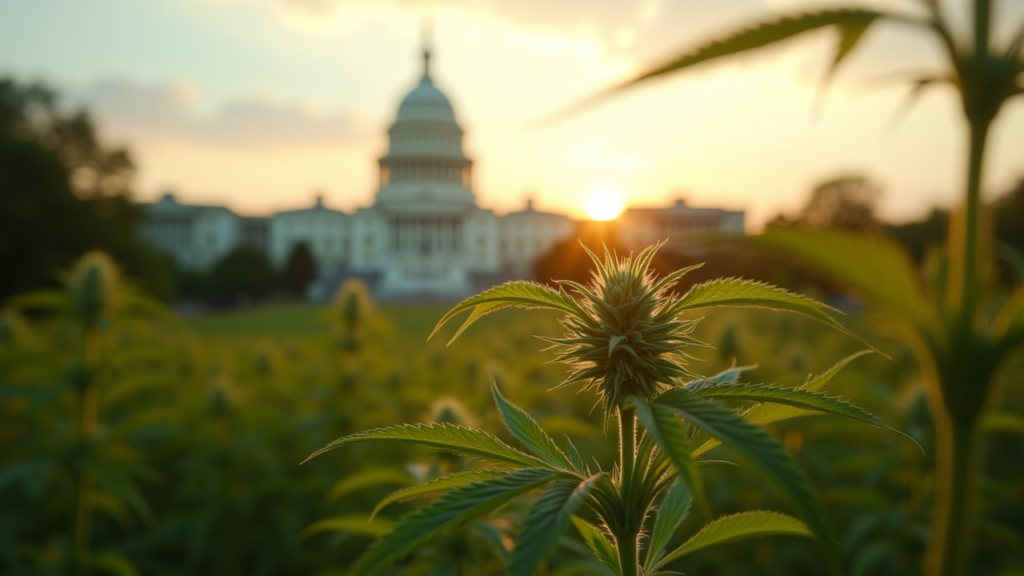
The clock is ticking for the hemp industry. On November 12, 2026, a sweeping federal ban on intoxicating hemp products officially takes effect — and it’s going to reshape the entire cannabis and hemp landscape in America.
If you use delta-8 THC, HHC, THCA flower, or any hemp-derived product that gets you high, this directly affects you. Here’s everything you need to know — what’s being banned, how we got here, who actually profits, and what to do before the deadline.
What’s Being Banned
The ban targets what regulators call “intoxicating consumable hemp products.” Specifically, it covers:
- Synthetic cannabinoids like delta-8 THC (converted from CBD in a lab)
- Unnatural cannabinoids like HHC (hexahydrocannabinol)
- Products exceeding 0.3% total THC — and this now includes THCA, which is the big change
- Products exceeding 0.4 milligrams of total THC per container
That last point about THCA is the real game-changer. Under the 2018 Farm Bill, hemp was defined as cannabis with less than 0.3% delta-9 THC. Smart operators figured out that THCA — which converts to delta-9 when heated — wasn’t counted. That loophole allowed “hemp” flower with 20%+ THCA to be sold legally across the country. That loophole is now officially closed.
Read the 0.4mg limit one more time: per container. Not per serving. Not per gram. Per entire container. A standard bottle of full-spectrum CBD oil — the kind millions of Americans use daily for pain, anxiety, and sleep — typically contains far more than 0.4mg of total THC. Under these new rules, that bottle becomes illegal too.
Section 781 and the 95% Number
The provision has a name: Section 781, signed into law in November 2025 as part of the government-reopening appropriations package. The U.S. Hemp Roundtable estimates that Section 781 will eliminate roughly 95% of hemp-derived cannabinoid products currently sold in the United States.
The economic impact is staggering. The hemp-derived cannabinoid market generates an estimated $30 billion in annual revenue and supports roughly 300,000 jobs. States that have built regulatory frameworks and tax structures around legal hemp products stand to lose over $1.5 billion in combined tax revenue.
Legal challenges are expected. Industry groups argue Section 781 was passed without adequate public comment, and that the 0.4mg per container limit is arbitrary and scientifically unsupported. Several states have announced they will not enforce federal hemp restrictions, setting up potential conflicts with federal agencies.
How We Got Here
In November 2025, President Trump signed a government-reopening appropriations package that included a provision specifically targeting intoxicating hemp products. The provision gave the industry one year — until November 12, 2026 — to comply.
Then on March 5, 2026, the House Committee on Agriculture voted 34-17 to approve House Resolution 7567 — the 2026 Farm Bill. 34 to 17. Remember that number. That is the vote that decided the fate of an entire legal industry, with zero amendments to delay or soften the November ban. Multiple amendments were on the table. Some would have pushed the effective date back by a year. Others would have raised the 0.4mg cap to something closer to what is actually on shelves. Every single one was rejected.
Rep. James Baird of Indiana had filed an amendment to delay the ban. He’d also introduced a standalone bill in January — the Hemp Planting Predictability Act — that would have pushed the deadline back two years. But Baird was absent from the markup. His wife Danise had passed away on March 1 from complications of a car accident. Committee Chairman Glenn Thompson and Ranking Member Angie Craig said Baird intended to withdraw the amendment anyway. Thompson argued the hemp product issue falls outside the Agriculture Committee’s jurisdiction. Which is a convenient way to say “not our problem” about a ban that will devastate agricultural businesses in every state.
To the bill’s credit, it does include some support for industrial hemp farmers — fiber and grain programs, expanded USDA testing access, more state flexibility. But the $30+ billion consumer market in hemp-derived intoxicants? That’s all on the chopping block, and Congress just signaled they’re fine with it.
Who Actually Profits From the Ban
The headline writes itself: “Federal Hemp Ban Destroys Industry.” It is almost true. The part it leaves out is that industries do not vanish when $180 million in legal demand gets outlawed. The demand keeps existing. Somebody keeps filling it. The only thing that changes is who. Here is who wins.
Winner #1: The Multi-State Cannabis Operators
The big tell in Washington is which industry group is not fighting the hemp ban — the U.S. Cannabis Council. The USCC is the lobbying arm of the multi-state operators (MSOs): Curaleaf, Trulieve, Green Thumb Industries, Verano, Cresco Labs. These are the publicly traded cannabis companies that sell THC products through state-licensed dispensaries.
For the MSOs, hemp-derived THC has been a nightmare. A delta-9 gummy made from hemp ships across state lines for $15. A chemically identical delta-9 gummy made from licensed cannabis costs $40 in a Florida dispensary because of 280E taxes, state licensing fees, and lab compliance. Consumers noticed. MSO revenue growth has been flat for two years while hemp-derived THC exploded into a $28 billion market across all fifty states.
The MSOs want that $28 billion. The hemp ban hands it to them without a single new retail license.
“Every MSO earnings call for the last two years has blamed hemp competition for missed numbers. Now those numbers are about to fix themselves, and nobody has to build a store, hire a budtender, or open a new state. It is the softest landing in corporate America.” — Matt, Divine Tribe
Winner #2: The Alcohol Industry
This one is not subtle. The alcohol industry has been funding prohibition groups for longer than the cannabis industry has existed. The Wine & Spirits Wholesalers of America publicly opposed the 2018 Farm Bill’s hemp provisions. The Beer Institute funded studies linking cannabis to traffic deaths. Anheuser-Busch InBev has lobbied state legislatures in Texas, Tennessee, and Georgia against hemp-derived intoxicants every session since 2022.
Why? Because legal cannabis cannibalizes alcohol. Research published in the Journal of Health Economics found beer sales drop 13 to 20 percent in counties with legal recreational cannabis access. In states where hemp THC seltzers hit supermarket shelves — Minnesota, Tennessee, Kentucky — craft beer distributors reported high-single-digit volume declines in 2024 and 2025.
A 0.4mg cap is a kill shot for every hemp THC seltzer in America. On November 13, 2026, the beverage aisle that had been losing real shelf space to THC drinks goes back to selling beer.
Winner #3: Big Pharma — Especially the Opioid Crowd
The most famous cannabis-prohibition funder of the last decade was Insys Therapeutics — the fentanyl maker that spent $500,000 to defeat Arizona’s 2016 legalization measure before its founder was convicted of racketeering and its sales reps went to prison for bribing doctors. The pattern did not die with Insys.
Pharmaceutical companies have a generational interest in making sure cannabis and its analogs stay unavailable without a prescription. Every hemp-derived CBD tincture sold for anxiety is a lost Xanax script. Every delta-9 gummy sold for sleep is a lost Ambien. Every THC beverage sold for chronic pain is a lost oxycodone refill.
The industry’s current strategy is cleaner than Insys. Instead of funding prohibition directly, they support rescheduling cannabis to Schedule III — which does three things at once: makes cannabis a pharmaceutical-track substance requiring FDA approval for drug claims, gives MSOs a tax break (eliminates 280E) so pharma-aligned capital can acquire them at a discount, and kills the over-the-counter hemp-derived alternatives that currently let consumers self-medicate without a doctor. You do not need to fund prohibition if you can control the only legal substitute.
Winner #4: Tobacco, Quietly
Altria, the parent of Philip Morris USA, owns 41 percent of Cronos Group, one of the largest cannabis companies in North America. British American Tobacco owns 20 percent of Organigram. Imperial Brands has a stake in Auxly Cannabis. The tobacco giants positioned for cannabis legalization years ago, betting on a consolidated legal market where they already own the distribution and compliance rails.
Hemp-derived THC broke that bet. It let small operators sell intoxicating cannabinoids nationwide without needing Altria’s regulatory expertise, distribution network, or capital. The 0.4mg cap resets the bet. When the dust settles in November, the only legal intoxicating cannabis in America will be the kind sold through state-licensed dispensaries — a market tobacco spent the last decade buying into.
The 0.4mg Number Is The Tell
Ask yourself: if the goal were consumer safety, what limit would you set? Probably a per-serving cap in the 2 to 5mg range, matching what adult-use states already regulate. Mandatory child-resistant packaging. Required lab testing. Age verification at point of sale. All of that exists in state-regulated markets right now.
The federal bill does none of it. It does not raise the testing bar. It does not mandate packaging. It does not set an age floor. It just drops the ceiling so low that no functional product can comply.
That is not safety policy. That is competitive policy. The 0.4mg cap is not designed to protect consumers — it is designed to make the hemp supply chain unworkable so the regulated-cannabis supply chain captures the demand.
“If this were really about kids getting into gummies, they would mandate childproof packaging and call it done. Instead they picked a dose limit that makes the product itself illegal. That’s not a safety rule. That’s a closing order.” — Matt, Divine Tribe
States Are Moving Faster Than The Feds
While the federal ban sets the ceiling, states are not waiting. Texas banned THCA flower as of March 31, 2026. Ohio’s Senate Bill 56 took effect March 20 and banned all intoxicating hemp products, including THC and CBD beverages. Tennessee implemented its own hemp restrictions effective January 1, 2026 — before the federal rules even kicked in, and Tennessee was one of the biggest hemp markets in the country. Pennsylvania’s Senate Bill 49 is linking hemp restrictions to adult-use legalization — wedging the two bills together so anti-hemp legislators can claim a win either way.
The pattern is obvious. States that never liked hemp loopholes are closing them. States that did benefit from hemp commerce are realigning with the coming federal standard so their regulated cannabis industry does not have to compete with cheaper hemp-derived products once the federal ban kicks in.
The Rescheduling Head-Fake
President Trump issued an executive order directing his administration to accelerate federal cannabis rescheduling. That sounds like good news until you read the fine print. Rescheduling still has to clear the Department of Justice and the Drug Enforcement Administration. There is no timeline. There is no guaranteed outcome. And even if cannabis moves from Schedule I to Schedule III, that does not legalize recreational use or save the hemp industry from the November ban. It helps medical cannabis companies with their taxes. It does not help the hemp farmer in Kentucky.
“Everyone pointing at the rescheduling headline as if it cancels the hemp ban is missing the point. Schedule III cannabis and intoxicating hemp are two different legal tracks. One is moving forward slowly. The other is getting shut down in seven months. Both things are true at once.” — Matt, Divine Tribe
Who This Hurts
Before we get to enforcement and what-to-do, the losers are easy to name. The Kentucky hemp farmer who bet his 2026 season on delta-9 contracts. The two-person gummy company in Minnesota that built a brand from a home kitchen. The smoke shop owner in Texas who finally had something legal to sell to adults. The truck-stop chain in Tennessee that stocked hemp seltzers. The mom-and-pop distillers in Vermont who launched a THC beverage line.
Every one of them was operating legally under rules Congress itself wrote in the 2018 Farm Bill. Every one of them has seven months before that legal ground disappears.
Consumers in states without legal recreational cannabis will feel this hardest. For millions of Americans in prohibition states, hemp-derived products have been their only legal access to cannabinoids. That access is about to vanish.
What Products Will Disappear
After November 12, the following products will be federally illegal unless sold through a state-licensed cannabis dispensary:
- Delta-8 THC gummies, vapes, tinctures, and edibles
- HHC products of all kinds
- THCA flower — the “legal weed” sold in smoke shops nationwide
- High-potency hemp edibles and beverages exceeding the 0.4mg total THC limit (which is basically all of them)
- THC-P, THC-O, and other novel cannabinoids
- Many full-spectrum CBD oils — trace THC above the new limit kills them too
The only hemp products likely to survive are those with virtually zero THC — isolate-based products that strip out everything except pure CBD. Ironically, those are the products many users and researchers say are less effective because they lack the full spectrum of cannabinoids working together.
The Enforcement Question
The big unknown is enforcement. Products that fall outside the new hemp definition will technically be subject to the federal Controlled Substances Act. But the DEA, FDA, and state agencies all have different priorities and resources.
Legal experts are already debating how enforceable the ban really is. With thousands of retailers selling these products across all 50 states, a sudden crackdown on November 12 seems unlikely. More probable is a gradual enforcement ramp-up, starting with manufacturers and distributors. But make no mistake — the legal risk is real. Businesses that continue selling banned products after November 12 will be operating outside federal law.
What Consumers Should Do
If you’re a consumer, start paying attention to what’s in the products you buy. Look for lab reports and understand what cannabinoids you’re consuming. Products with CBD, CBG, CBN, and other non-intoxicating cannabinoids should remain legal — but verify with the manufacturer that their formulation comes in under the 0.4mg per container threshold.
Stock up within reason on the hemp edibles and beverages you actually use, keeping in mind the shelf life on most of these products is a year or less. And get familiar with your state’s cannabis laws — if you live somewhere with adult-use or even decent medical access, the shift from hemp to regulated cannabis will be annoying but survivable. If you live in a prohibition state that relied on hemp for legal access, November is going to feel like a light switch turning off.
What Businesses Should Do
If you’re in the hemp industry, now is the time to diversify. Companies that built their entire business around delta-8 or THCA need contingency plans — whether that means pivoting to compliant products, entering state-licensed cannabis markets, or advocating for legislative change.
If you are a farmer with a 2026 hemp contract, read the force majeure clause. If the product cannot legally enter commerce, the contract may be voidable. Talk to an attorney before signing anything new for the 2026 season.
And everyone should be contacting their representatives. The bill still has to pass the full House and the Senate. A single senator can place a hold. A handful of farm-state Republicans could break the coalition if constituents made enough noise. It is not done until it is done.
The Part Nobody Will Say Out Loud
Prohibition has always been this. The 1937 Marihuana Tax Act was lobbied into existence by DuPont (which had just patented a hemp-replacing plastic) and William Randolph Hearst (whose timber holdings backed his paper mills and who feared hemp-based paper). The 1970 Controlled Substances Act expanded the scope but kept the same pattern: criminalize the decentralized version, consolidate the legal version among incumbents, claim health and safety the entire time.
The 2026 hemp ban is that pattern in its modern form. Small farmers lose. Consumers pay more. Lobbying incumbents absorb the market. The press prints the safety angle and moves on.
The only thing that has ever broken this cycle is enough people paying attention to see it happening in real time. Which is exactly the point of writing it down while the paint is still wet. November 12 is coming fast.
References
- Whitney Economics, “2024 U.S. Hemp-Derived Cannabinoid Market Report” — hemp-derived cannabinoid market sized at $28.4B retail in 2023
- U.S. Hemp Roundtable — 95% market elimination estimate under Section 781
- Public lobbying disclosures, Wine & Spirits Wholesalers of America (WSWA), 2022–2025 state filings in TX, TN, GA
- Baggio, Chong & Kwon, “Marijuana and Alcohol: Evidence Using Border Analysis and Retail Sales Data,” Journal of Health Economics, 2020
- DOJ press release, “Founder and Four Executives of Insys Therapeutics Convicted,” May 2, 2019
- Altria Group 2018 investor release on $1.8B Cronos Group investment, 45% stake (since diluted to ~41%)
- British American Tobacco 2021 press release on $221M Organigram investment, ~19.9% stake
- Herer, The Emperor Wears No Clothes, 1985; Bonnie & Whitebread, The Marihuana Conviction, 1974
- Marijuana Moment — Congressional researchers on rescheduling and hemp ban
- Frier Levitt — Federal redefinition of hemp and 2026 compliance risks
- Fox Rothschild — The 2026 Extensions Act and hemp