
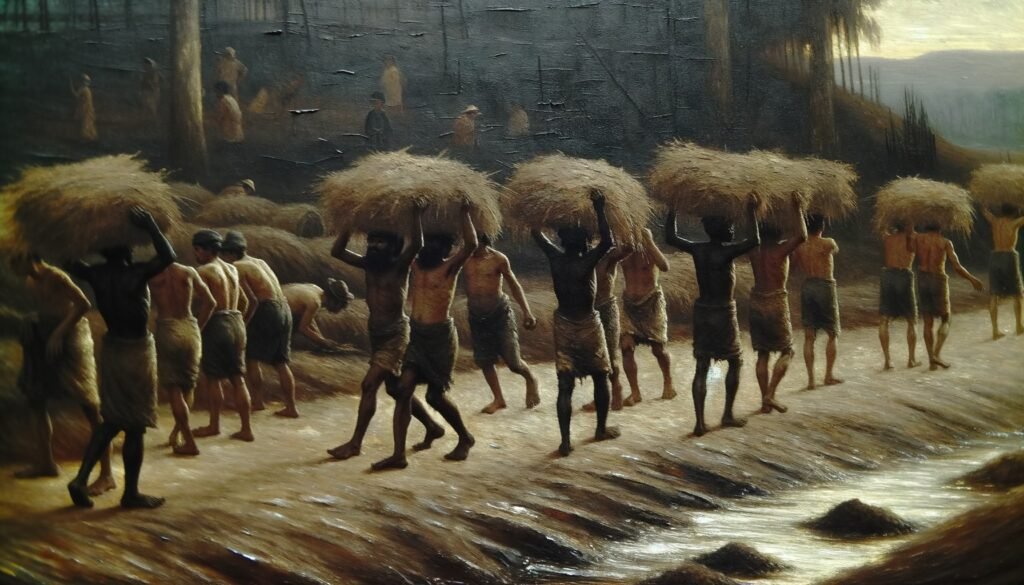
The Invisible Hands Behind the Hemp Trade
When we talk about hemp’s golden age — the era when it powered the world’s navies, shaped geopolitics, and fueled global trade — we usually talk about empires, admirals, and treaties. What we don’t talk about enough is who actually grew and processed the hemp. The answer, on two continents, is the same: enslaved and bonded laborers who never saw a fraction of the wealth their work created.
The history of hemp is inseparable from the history of forced labor. And it’s time we faced that honestly.
23 Million Serfs: Russia’s Hemp Machine
Russia’s dominance in the global hemp trade — supplying over 90% of the British Royal Navy’s rope and canvas — wasn’t built on technological innovation or superior farming techniques. It was built on serfdom: a system of hereditary bondage that tied roughly 23 million human beings to the land and to the will of their noble masters.[1]
In Russia’s hemp-growing heartland — the black-earth regions of central Russia — 74% of serfs labored under barshchina, the corvée system that required them to work their lord’s fields three or more days per week, unpaid, in addition to farming their own small plots to survive.[2] The hemp they grew went to market. The profits went to the nobility. The serfs got nothing.
The Brutal Reality of Hemp Processing
Growing hemp was hard. Processing it was brutal. Every step of turning raw hemp stalks into usable fiber required grueling manual labor that destroyed workers’ bodies:
Retting — Harvested stalks were submerged in stagnant water for weeks to rot the outer bark away from the inner fibers. Workers stood waist-deep in foul, bacteria-laden water, pulling heavy bundles in and out. The stench was legendary — entire villages could be smelled from miles downwind.[3]
Breaking — Once retted, the dried stalks had to be smashed with heavy wooden mallets or run through hand-cranked breaking machines to crack the woody core away from the fibers. This was back-breaking repetitive labor, performed hour after hour.
Scutching — Workers scraped and beat the broken stalks to separate the usable fiber from the remaining woody fragments. A skilled worker could process roughly 15 pounds of fiber per day — a pitiful output for such exhausting work.[4]
Hackling — The final step required pulling fibers through sets of increasingly fine metal spikes to comb and align them for spinning into rope. Workers’ hands were perpetually cut, calloused, and bleeding from the sharp metal teeth.
This was the supply chain that kept the British Empire afloat: serf labor in Russian fields, processed through human suffering, shipped through Baltic ports, and woven into the ropes that held HMS Victory together at Trafalgar.
Cannabis on the City Emblem
The Russian town of Dmitrovsk, located in the Oryol region — one of the historic centers of hemp cultivation — still carries a cannabis plant on its official coat of arms to this day.[5] It’s a striking reminder: hemp wasn’t something Russia was embarrassed about. It was a source of national pride and wealth. The fact that the wealth was extracted through bondage was simply how things worked.
Kentucky’s Parallel: 40,000 Tons on the Backs of Slaves
Across the Atlantic, the same story played out with different faces. Kentucky became America’s hemp capital in the 1800s, producing a peak of 40,000 tons annually by 1850. Every pound of it was processed by enslaved African Americans.[6]
The reason was simple and ugly. Hemp processing — the same retting, breaking, scutching, and hackling that serfs endured in Russia — was so physically brutal and unpleasant that free white laborers refused to do it. An 1836 account stated plainly:
“Hemp is so laborious that scarcely any white man will work at it.”[7]
Historians have been even more direct about the connection. As Kentucky hemp researcher Edward T. Dodge documented:
“Without hemp, slavery may not have existed in Kentucky.”[8]
That’s not hyperbole. Hemp cultivation was the primary economic justification for maintaining a large enslaved workforce in a state that wasn’t suited to cotton or sugar. The plant and the institution were economically fused — you couldn’t have one without the other.
Emancipation and Aftermath
Russia’s Emancipation Reform of 1861 formally abolished serfdom, freeing 23 million bonded laborers. The economic impact was transformative — economists Markevich and Zhuravskaya estimated that emancipation ultimately boosted Russia’s GDP by 17.7% as freed serfs became productive participants in the economy rather than coerced laborers.[9]
In the United States, the 13th Amendment in 1865 ended slavery, and Kentucky’s hemp industry collapsed almost immediately. Without forced labor willing to endure the processing, and facing competition from imported Manila hemp (abaca) and eventually wire rope, American hemp production cratered.
Both cases proved the same point: the hemp industry as it existed could not survive without forced labor. When the people were freed, the old model died.
Honoring the Full Truth
I’m a hemp advocate. I believe in this plant — its industrial potential, its environmental benefits, its place in a sustainable future. But I refuse to romanticize the past.
The golden age of hemp was built on bondage. In Russia, 23 million serfs grew and processed the fiber that held the British Empire together. In Kentucky, enslaved people did work so brutal that no free person would touch it. The wealth that flowed from hemp — the fortunes of Russian nobles, the plantation economies of the American South — was stolen labor, converted into fiber, converted into gold.
When we push for hemp legalization and celebrate hemp history, we need to carry this truth with us. Not as guilt, but as responsibility. The modern hemp industry has a chance to be different — to be built on fair labor, fair wages, and honest accounting of where we’ve been. But only if we stop pretending the old days were some kind of paradise.
They weren’t. Not for the people who did the actual work.
Sources
- Wikipedia — “Serfdom in Russia”
- Encyclopedia.com — “Barshchina”
- Russia Beyond — “How Hemp Shaped Russian History”
- Brewminate — “A History of Hemp in Colonial America”
- Russia Beyond — Dmitrovsk City Emblem
- Kentucky Hempsters — “Kentucky Hemp History”
- Brewminate — 1836 Hemp Labor Account
- Edward T. Dodge, cited in Kentucky Hempsters
- Markevich & Zhuravskaya, cited in Wikipedia — “Emancipation Reform of 1861”