
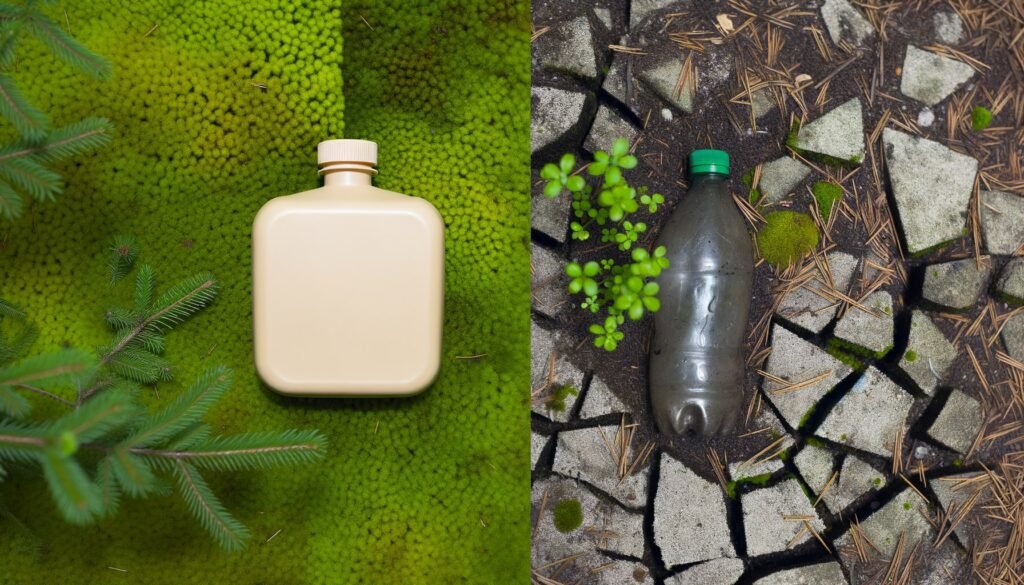
Here’s a number that should keep you up at night: 400 to 1,000 years. That’s how long a single petroleum-based plastic bottle takes to decompose. Every plastic fork, every grocery bag, every shampoo bottle you’ve ever thrown away still exists somewhere on this planet. It will exist long after you, your children, and your grandchildren are gone.
Hemp plastic biodegrades in 3 to 6 months.
What Is Hemp Plastic?
Hemp plastic is a bioplastic made from the cellulose fibers of the hemp plant. Hemp stalks contain up to 65-70% cellulose, which can be extracted and processed into a wide range of plastic products — from packaging and containers to automotive parts and consumer goods. The resulting material is non-toxic, free of BPA and phthalates, and contains none of the harmful endocrine disruptors found in conventional plastics.
When hemp plastic reaches the end of its useful life, it breaks down through natural composting. No microplastics leaching into the ocean. No toxic chemicals seeping into the groundwater. It goes back to the earth.
The Carbon Advantage
The environmental case for hemp plastic goes beyond biodegradability. During its growing cycle, hemp consumes roughly four times more CO2 per acre than most other crops and trees. One acre of hemp can absorb up to 10 tons of CO2 from the atmosphere in a single growing season of about 100 days.
So the math works like this: grow hemp, absorb CO2, make plastic, use it, compost it, grow more hemp. It’s a closed loop. Compare that to petroleum plastic: drill oil, refine it (emitting CO2), manufacture plastic (emitting more CO2), use it for 20 minutes, and then it sits in a landfill for 500 years leaching chemicals. One is a cycle. The other is a death spiral.
We knew this in 1941 when Henry Ford built a car from hemp plastic and hit it with a sledgehammer to prove it wouldn’t dent. Eighty-five years later, we produce 400 million tons of petroleum plastic per year. That’s not ignorance — that’s a choice. A bad one.
Who’s Already Using Hemp Plastic?
This isn’t fringe technology. Ford, General Motors, BMW, Honda, and Mercedes-Benz all use hemp-based biocomposites in their vehicles — door panels, dashboards, trunk liners, and structural components. These companies didn’t switch to hemp because they’re environmentalists. They switched because hemp composites are lighter, stronger, and cheaper to produce at scale than fiberglass alternatives.
On the consumer side, companies like The Hemp Plastic Company and Sana Packaging are manufacturing hemp-based packaging for the cannabis, food, and consumer goods industries. Sana Packaging, based in Colorado, produces 100% plant-based, reclaimed ocean plastic, and hemp plastic containers that are designed to biodegrade at end of life.
The Cost Problem — And Why It’s Temporary
Right now, hemp plastic costs roughly twice as much as petroleum plastic. That’s the honest truth, and it’s the main reason adoption has been slow. When you can make a plastic bag for a fraction of a cent from petroleum, it’s hard to compete.
But that cost gap is narrowing every year as hemp cultivation scales up and processing technology improves. And it completely ignores the externalized costs of petroleum plastic — the ocean cleanup, the healthcare costs from endocrine disruptors, the landfill management, the microplastics in our blood. When you factor in the true cost, petroleum plastic is the most expensive material on the planet. We just don’t put it on the price tag.
The Bottom Line
We have a material that biodegrades in months instead of centuries. That absorbs CO2 instead of producing it. That contains no toxic chemicals. That major automakers already use in mass production. The only thing keeping petroleum plastic dominant is subsidized oil, lobbying, and inertia.
Henry Ford showed us the way in 1941. Eighty-five years later, we’re drowning in petroleum plastic — 8 million tons of it enter the ocean every year. We don’t have a technology problem. We have a willpower problem. The solution has been growing in fields since the beginning of agriculture. It’s time we used it.