
The cement industry has a dirty secret — actually, it’s not even a secret. Cement production is responsible for approximately 8% of all global CO2 emissions. If the cement industry were a country, it would be the third-largest emitter on Earth, behind only China and the United States. Every new building, every new road, every new sidewalk adds to the problem.
Now imagine a building material that does the opposite. One that absorbs carbon dioxide instead of producing it. That material exists. It’s called hempcrete, and it’s been used in construction since the 1990s.
What Is Hempcrete?
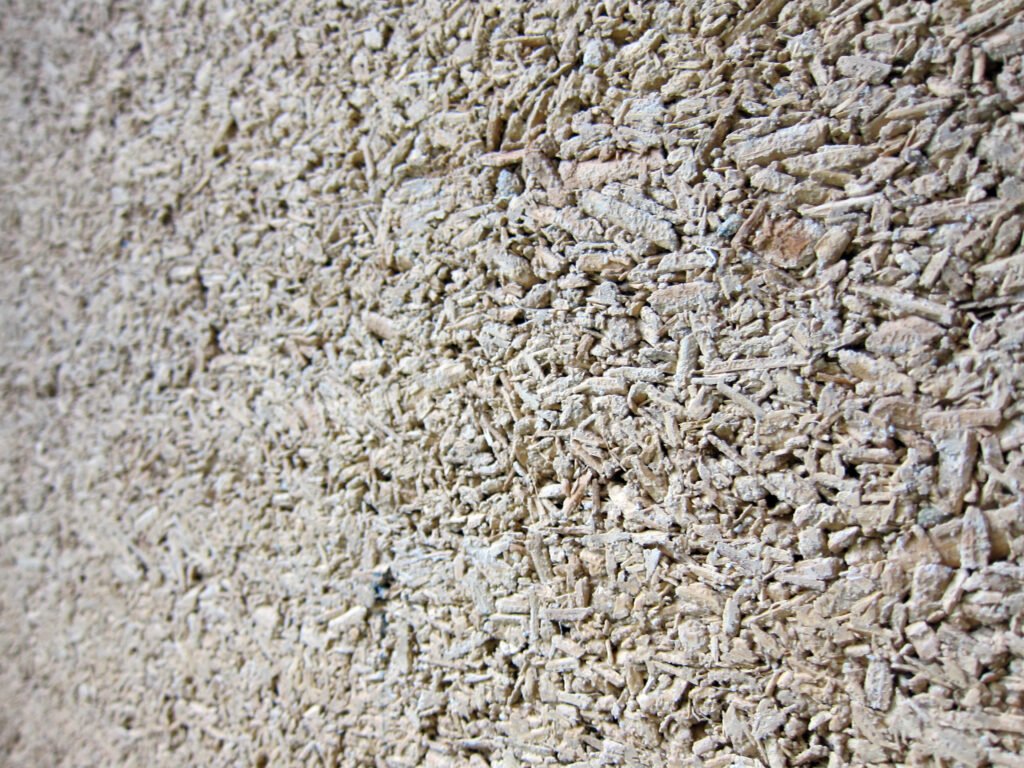
Hempcrete is a biocomposite made from the woody inner core of the hemp plant (called the “hurd” or “shiv”), mixed with a lime-based binder and water. The result is a lightweight, insulating material that can be used for walls, floors, and roofing insulation. It’s not a theoretical material — it’s been used in buildings across France since the early 1990s, and it’s now gaining traction in the UK, United States, Canada, and Australia.
The Carbon Math That Changes Everything
Here’s where hempcrete breaks the rules of conventional construction. During the growing phase, hemp absorbs massive amounts of CO2 from the atmosphere. Then, during the curing process, the lime binder continues to absorb CO2 through carbonation — a process that goes on for decades after the wall is built.
The net result: hempcrete sequesters between 165 and 307 kilograms of CO2 per cubic meter, depending on the mix ratio and density. Compare that to conventional concrete, which produces roughly 400 kg of CO2 per cubic meter. The swing is staggering — instead of adding carbon to the atmosphere, your walls are pulling it out.
Your house could literally be fighting climate change while you sleep in it. That’s not a slogan — that’s the chemistry of hempcrete.
Fire Resistant, Mold Resistant, and a Superior Insulator
Hempcrete isn’t just good for the planet — it performs. It’s naturally fire-resistant, capable of withstanding direct flame for hours without structural failure. It’s mold and pest resistant because the lime binder creates an alkaline environment that fungi and insects avoid. And its thermal performance is exceptional — hempcrete walls “breathe,” regulating humidity and temperature in a way that reduces heating and cooling costs by up to 50-70% compared to conventional construction.
SOM’s Urban Sequoia: A Hemp High-Rise
In 2022, Skidmore, Owings & Merrill (SOM) — one of the largest architecture firms in the world — unveiled the Urban Sequoia concept: a high-rise building designed with bio-based materials including hempcrete and bio-cement that would absorb more carbon over its lifetime than it emits during construction. SOM estimated that a single Urban Sequoia tower could sequester up to 1,000 tons of carbon per year. Scale that to a city, and the math is transformative.
The Honest Limitation
Hempcrete is not load-bearing. It can’t replace structural concrete in foundations, columns, or beams. It needs a timber or steel frame to carry structural loads, with hempcrete filling in as insulation and wall material. That’s a real limitation, and anyone who tells you hempcrete can do everything concrete does is overselling it.
But here’s the thing — most of the concrete in a typical building isn’t structural anyway. It’s walls, insulation, and cladding. That’s exactly where hempcrete excels. Pair it with engineered timber framing, and you’ve got a building that sequesters carbon at every layer.
Hemp literally reverses climate change while building your house. We have a material that absorbs CO2, resists fire, prevents mold, insulates better than fiberglass, and has been proven in buildings for over 30 years. The only thing missing is the political will to scale it.