
Hemp Was the Oil of the 1800s
Before petroleum, before coal dominated global trade, there was hemp. In the age of sail, hemp wasn’t some niche crop — it was the single most important strategic material on Earth. Every warship, every merchant vessel, every fishing boat depended on hemp rope, hemp canvas, and hemp caulking to function. Without hemp, you didn’t have a navy. Without a navy, you didn’t have an empire.
HMS Victory — Nelson’s flagship at Trafalgar — required 26 miles of hemp rope and 6,500 square yards of hemp canvas. A single first-rate ship of the line consumed roughly 80 tons of hemp in its rigging and sails. The British Royal Navy, the most powerful military force on the planet, operated hundreds of these vessels simultaneously. The demand was staggering.[1]
And there was really only one place to get it.
Russia: The OPEC of Hemp
By the late 1700s, Russia supplied 90 to 96 percent of the British Royal Navy’s hemp.[2] This wasn’t an accident. Peter the Great had deliberately built Russia into a hemp superpower in the early 1700s, modernizing cultivation and undercutting Swedish competitors to capture the European market. Russian hemp — grown across the vast black-earth regions by millions of bonded serfs — was the finest in the world for maritime use.[3]
The numbers tell the story. Britain imported over 30,000 tons of Russian hemp annually at its peak. The entire British maritime system — naval and commercial — ran on Russian fiber. If that supply was cut off, the Royal Navy would rot at its moorings within two years as ropes frayed and sails shredded.[4]
This single economic fact shaped the geopolitics of an entire continent.
Napoleon’s Gamble: The Continental Blockade
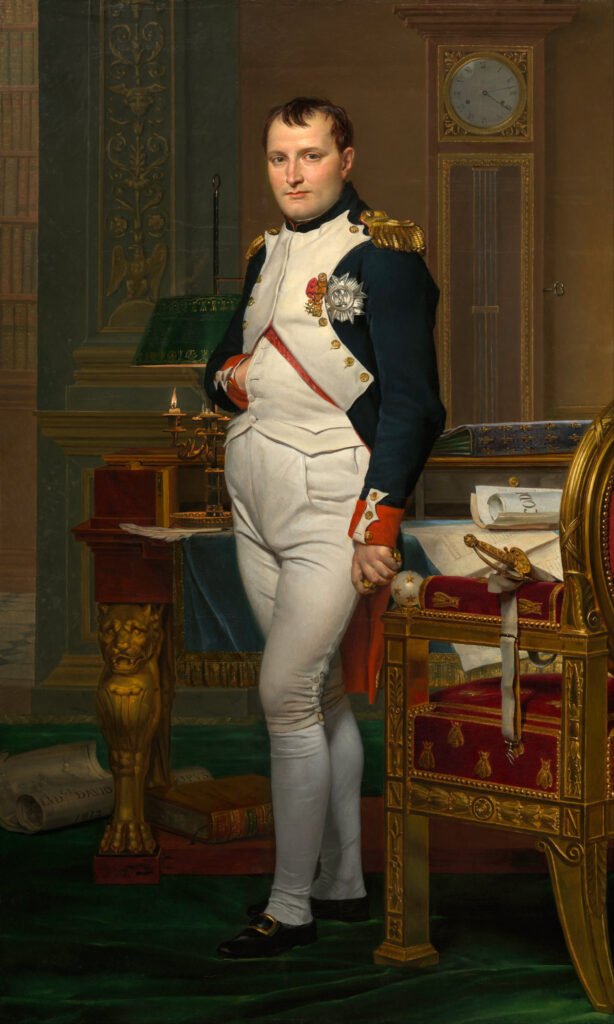
Napoleon understood this dependency perfectly. In November 1806, he issued the Berlin Decree, establishing the Continental System — a trade embargo designed to strangle Britain economically by cutting off all European trade with the island nation. The primary strategic target wasn’t French wine or German steel. It was Russian hemp.[5]
At the Treaty of Tilsit in July 1807, Napoleon met Tsar Alexander I on a raft in the middle of the Niemen River and extracted a promise: Russia would join the Continental System and stop selling hemp to Britain.[6]
On paper, it was a masterstroke. Cut the hemp, kill the navy, collapse the empire.
In reality, it was the beginning of the end for Napoleon.
Russia Couldn’t Stop — and Wouldn’t
The Russian nobility had a problem. Their entire economic model depended on hemp exports. Vast estates across central Russia employed millions of serfs growing and processing hemp, and the profits flowed through Baltic ports to British buyers. The hemp trade was the backbone of the Russian aristocratic economy.[7]
Tsar Alexander found himself caught between Napoleon’s demands and his own nobles’ fury. Russia began quietly ignoring the blockade almost immediately. Trade continued through neutral ports, third-party intermediaries, and outright smuggling.
Over 600 American clipper ships took advantage of the chaos, sailing into Russian ports under the Stars and Stripes to buy hemp and resell it to Britain. John Quincy Adams, then the American minister to Russia, reported extensively on this booming trade. The Americans were getting rich as middlemen in a geopolitical hemp war.[8]
Napoleon watched Russia’s defiance with growing rage. Every bale of hemp that reached British dockyards was a nail in the coffin of his grand strategy.
The Battle of Copenhagen: Britain’s Hemp Panic
The British weren’t passive in all this. They had already shown how far they’d go to protect their hemp supply. In 1801, when Tsar Paul I briefly joined an armed neutrality league that threatened Baltic trade, Britain sent a fleet under Admiral Nelson to Copenhagen. The resulting Battle of Copenhagen was fought explicitly to keep the Baltic — and its hemp trade routes — open.[9]
It was during this battle that Nelson famously put his telescope to his blind eye to “not see” the signal to withdraw. He won. The hemp kept flowing. Britain would fight anyone — even allied nations — to protect this supply chain.
612,000 Marched In. 112,000 Came Back.
By 1812, Napoleon had had enough. Russia’s continued hemp trade with Britain was undermining his entire continental strategy. In June, he assembled the Grande Armée — 612,000 soldiers, the largest invasion force Europe had ever seen — and marched east.[10]
What followed was one of the greatest military catastrophes in human history. The Russian scorched-earth strategy, the brutal winter, disease, starvation, and constant harassment destroyed Napoleon’s army. Of the 612,000 who crossed the Niemen River, roughly 112,000 returned. Total casualties on both sides approached one million dead.[11]
Historian Alfred Crosby of Boston University studied the hemp trade’s role in this disaster extensively and concluded that the hemp trade dispute was “as important as any other single factor in leading Napoleon to invade Russia”.[12]
Read that again. A million people died, the most powerful army in Europe was annihilated, and the trajectory of world history changed — over hemp.
A Plant That Built Empires Is Now Schedule I
Here’s what keeps me up at night. Hemp — the exact same plant — was so strategically vital that the largest military invasion in human history was launched partly to control its trade. Nations fought naval battles over it. Empires rose and fell based on who controlled the supply. The entire British Royal Navy, the force that shaped the modern world, literally could not function without it.
And today? That same plant sits on the Schedule I controlled substances list in the United States, classified alongside heroin as having “no accepted medical use” and “high potential for abuse.”
We went from fighting wars to secure hemp to making it illegal to grow. A million soldiers died for this plant at the gates of Moscow, and now you can get arrested for cultivating it in half the countries on Earth.
The next time someone tells you hemp prohibition is based on science or public safety, remind them that Napoleon Bonaparte thought hemp was important enough to bet his entire empire on. He was wrong about the invasion. He wasn’t wrong about the plant.
Sources
- Hempshopper — “Hemp and the Rule of the Seas”
- Margaret River Hemp Co — “Hemp Wars”
- Russia Beyond — “How Hemp Shaped Russian History”
- CIMSEC — “The Naval Stores Theory of the Russo-French War of 1812”
- Britannica — “Continental System”
- Britannica — “Treaties of Tilsit”
- Russia Beyond — Russian Nobility and the Hemp Economy
- Wikipedia — “Continental System” (American Shipping)
- Britannica — “Battle of Copenhagen (1801)”
- Wikipedia — “French Invasion of Russia”
- Wikipedia — French Invasion of Russia: Casualties
- Alfred Crosby (Boston University), cited in Margaret River Hemp Co