
I’m going to do something a little backwards, and I want to explain why.
The Cannabis Device Safety Institute is about to run its first test. Before a single sample gets pulled, before any lab has been paid, the full plan is already public at cdsi.click/tests/cdsi-r-001. Anyone can read it, poke holes in it, and tell me what I got wrong. Honestly, I’d rather hear it now than after the money is spent.
What we’re testing
One device: the Divine Tribe V5, a concentrate vaporizer. I’ll say the obvious part first. Divine Tribe is my company. That’s on the cover of the plan and it will be on the cover of the report. Other brands follow under the same plan. Starting with my own device means that if something ugly shows up, it shows up on my product first.
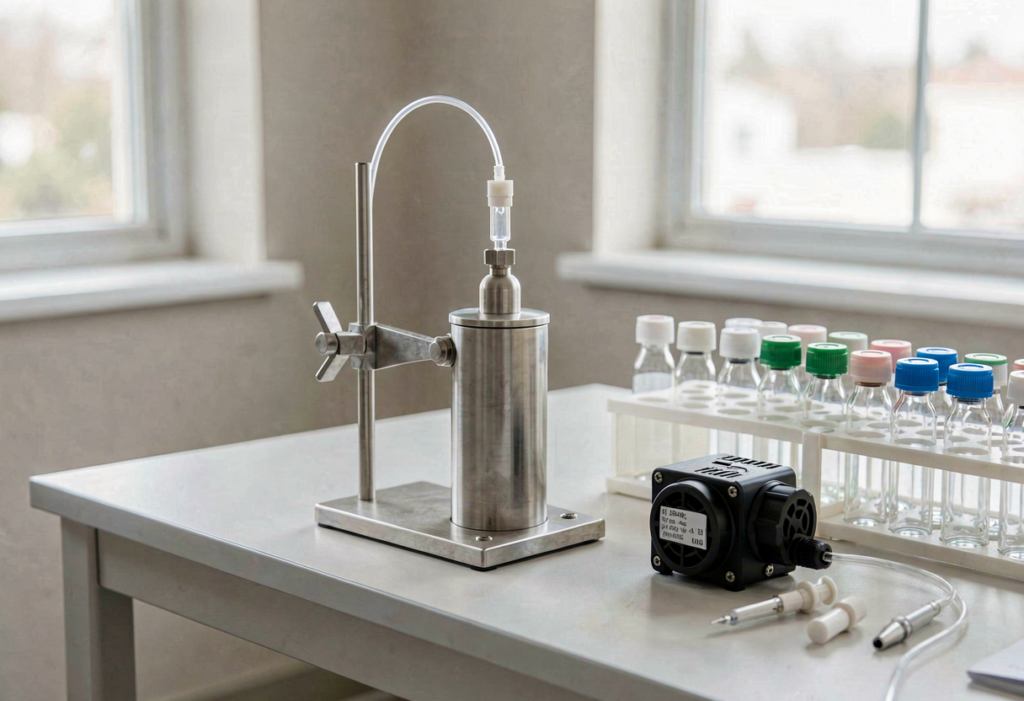
The heater gets fired empty at 500 °F for one-minute sessions. No cannabis, no concentrate, nothing loaded. That’s on purpose. If the heater is empty, anything that comes out of the mouthpiece came from the hardware. That’s the question nobody has a clean answer to yet: what does the device itself add to what you breathe?
500 °F is the top of the range we tell people to use. I picked the high end so the result reflects a realistic worst case, not a gentle one.
How it’s sampled
This part matters, so I’ll be specific. A vacuum pump pulls air through the device the whole minute, the same way a person inhaling would. Air goes in the device’s own intake, across the hot heater, and out the mouthpiece into the sampling tubes.
What we are not doing is putting the whole device in a heated box and measuring everything that gasses off it. That kind of test measures the battery, the plastics and the body at temperatures you’d never expose them to. It’s not what your lungs get. We only measure what comes out of the mouthpiece.
A thermocouple on the heater logs the real temperature every second, so the report says what the heater actually reached, not just what the dial said.
Two labs, two methods
The plan calls for two independent labs using two different methods, run on the same session:
- Lab A: industrial-hygiene sampling. I pull the samples myself on camera, using standard tubes for carbonyls (formaldehyde, acetaldehyde, acrolein and more), volatile organics, and metals, then ship them sealed with chain of custody to the lab.
- Lab B: a vape-emissions lab running its own puffing machine, with me in the room for every session.
If both labs agree, that’s a cross-check you can trust more than either one alone. If they disagree, that’s a finding too, and it gets published the same way.
Neither lab is engaged yet. Quote requests are out, and the labs get named in the report once they’re hired.
What gets published
All of it. The plan, video of every session I run, the temperature logs, photos of every serial number and sealed tube, the chain-of-custody forms, both labs’ raw reports unedited, a side-by-side table, and a plain-language summary.
One rule I’m holding myself to: nothing gets reported as “zero.” Zero isn’t something an instrument can measure. If a lab can’t detect something, the report says it was below that lab’s stated limit, for that chemical, at that temperature and session length. It sounds weaker. It’s the version that holds up.
There are no results yet. None. If you see anyone quoting numbers from this test before the report is out, they didn’t come from us.
Where you come in
This is the part I’m actually asking for help with.
If you know this science, read the plan and tell me where it’s wrong. The open questions are listed at the bottom: whether an empty heater is the right first test, how many sessions to stack per tube, which chemicals to add or drop, and what draw rate to use.
If you run a lab that does carbonyl, VOC or metals work, or vape emissions, and you’d quote this, I’d like to hear from you.
If you want to help pay for it, the first round runs somewhere around $1,000 to $1,700 for the first lab, based on older published prices, plus whatever the second lab quotes. CDSI is a 501(c)(3), so donations are tax-deductible. Details at cdsi.click/donate.
If you’re a consumer group or advocacy org that wants vaporizers tested under one shared method, so results can be compared across brands, let’s talk.
Reach me at matt@cdsi.click. It comes straight to me.
From where I sit, this is how it should work. Publish the plan before the run. Pay the lab, not pay to pass. Show everything, especially when it’s your own product on the bench.
Matt Macosko founded the Cannabis Device Safety Institute and owns Divine Tribe, which makes the device in this test.