
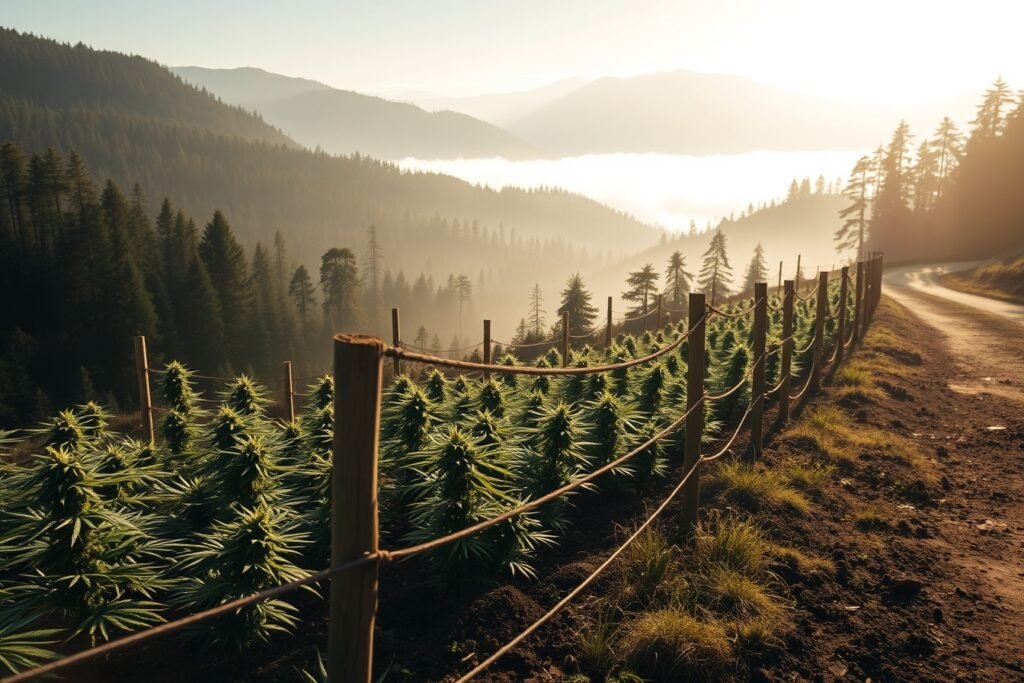
Humboldt County owns the single most valuable brand name in American cannabis.
Right now we are giving it away for free.
Not selling it. Not licensing it. Giving it away, one $20 eighth at a time, to anybody willing to print the word on a package.
I have lived here long enough to watch this industry go from almost entirely underground to one of the most regulated agricultural sectors in California. I have watched people make fortunes, lose everything, retire, leave, start over, and quit.
What worries me now is not that Humboldt cannabis is dying.
It is that Humboldt cannabis is becoming generic.
Those are different problems, and only one of them is fatal.
Nobody Marketed This Name Into Existence
Long before California legalized anything, farmers in these mountains built a reputation that traveled around the world without a single ad.
Small farms. Old genetics. Sun-grown flower. Generations of people who learned to grow here because their parents grew here.
Nobody ran a campaign telling the country Humboldt was special. The country figured it out on its own, and said it back to us for thirty years.
That almost never happens.
Ask anybody who has tried to build a brand from scratch what it costs to get strangers in other states to say your name without being paid to. It is close to impossible.
Humboldt did it accidentally, while illegal, with no budget.
The asset was never the acreage or the licenses. It was always the name.
Legalization Solved the Legal Problem and Created an Economic One
We were told legalization would bring Humboldt into the light, and in fairness, parts of that came true. Farmers can operate legally. Consumers can buy without risking arrest.
But legalization also did something nobody said out loud clearly enough at the time.
It forced Humboldt cannabis to compete as a commodity.
A small farmer up a dirt road is now on the same shelf, in the same category, as a hundred thousand square feet of light dep in the Central Valley backed by outside money.
And the person at the dispensary counter is looking at two jars.
$20. And $45.
Most of the time, price wins. Not because people do not care where their flower came from, but because nothing on that shelf gives them a reason to care.
Both jars just say cannabis.
Meanwhile the farmer is paying state taxes, testing fees, license renewals, compliance consultants, labor, insurance, water infrastructure and transportation, and competing on price against industrial scale.
That math does not resolve. Eventually something gives, and it is almost always the small farm.
We made Humboldt cannabis legal. We never made it valuable.
The Real Mistake Was Trying to Win on Volume
Humboldt should never have tried to be the place that grows the most cannabis in California.
Humboldt should have been fighting to be the place that grows the most valuable cannabis in California.
We are not going to beat a warehouse on cost. We should stop pretending that is the game.
A warehouse can be built anywhere, financed by anyone, staffed by anyone, and copied in any state the week after federal law changes.
What a warehouse cannot do is be from somewhere.
You can build a fifty million dollar indoor facility in any industrial park in America. You cannot build Humboldt County anywhere.
You cannot manufacture the ridges, the fog, the rivers, the forty years of selection work, or the families who did it.
That is not a marketing story. It is a physical fact, and it is the only kind of advantage that does not evaporate when somebody shows up with more money.
Napa Did Not Happen by Accident
Everybody reaches for the Napa comparison. It is the right one, but people usually reach for the wrong half of it.
The lesson of Napa is not that they had good dirt and a nice story. Plenty of places have that.
The lesson is that Napa drew a legal line on a map.
In 1981, Napa Valley became California’s first federally recognized wine appellation, with defined boundaries and rules about who may put the words on a bottle.[1]
That is what turned a regional reputation into a protected, enforceable, permanently premium asset. After that, the geography was part of the product by law, not by vibes.
Nobody outside the line gets to use the word.
Today nobody walks into a wine shop and asks for California wine. They ask for Napa. And they pay more for it, forever, because the name is fenced.
Humboldt has the reputation. Humboldt has never had the fence.
The Fence Is Being Built Right Now, and Almost Nobody Is Watching
Here is the part that turns this from an essay into a deadline.
California has a Cannabis Appellations Program. It is the cannabis version of what Napa got in 1981, run by the state Department of Food and Agriculture.
It lets a defined growing region petition to protect its name, so that only cannabis actually grown there, in the ground, in that place, can carry it.[2]
The program is not open yet. CDFA has been finishing the rulemaking, and currently expects to open the program in summer 2026.[3]
Which means, as of today, zero cannabis appellations exist in California.
Not one. The map is completely blank.
Every region in this state is standing at the same starting line. And the region with the biggest head start in name recognition, by a mile, is this one.
That is the whole opportunity, and it has a clock on it.
Interstate Commerce Is the Second Clock
Right now we are sealed inside California. Flower cannot legally move from Humboldt to Pennsylvania just because somebody in Pennsylvania wants it.
Federal law still says no.
But if that changes, and it is more a question of when than if, the customer stops being the person in a dispensary in Eureka or Oakland.
The customer becomes somebody in New York, Texas, Michigan or Florida who has been hearing the word Humboldt their entire adult life and has never once been able to legally buy it.
That is a market that already wants us. It just cannot reach us yet.
And here is the trap.
The brand has to be built and protected before that door opens, not after.
On the day interstate commerce becomes real, the companies with capital will already have their distribution, their shelf deals, their packaging and their legal teams.
If the name is not fenced by then, they will use it. They will put Humboldt on a bag of flower grown in a warehouse two thousand miles from here, and there will be nothing anybody can do about it.
Twenty years from now that word could mean nothing more than a font choice.
What They Cannot Buy
Corporations can buy land here. They can buy licenses, equipment, genetics and advertising. They can outspend every farm in this county combined.
What they cannot do is go back forty years and become part of how this happened.
There are farms here run by the second and third generation of the same family. There are cuts with a documented history in these hills. There are whole communities where cultivation is not an industry, it is the culture.
None of that is for sale, and none of it can be recreated on a spreadsheet.
That is the inventory. It is the only inventory that appreciates.
What This Looks Like If We Get It Right
Picture a dispensary shelf in another state a few years from now.
Instead of another anonymous brand with a clever logo, the label says the region. Verified origin. Named farm. Named cultivar.
Sun grown, in the ground, in a place with a boundary you could drive to.
At that point you are not selling an eighth. You are selling provenance.
You are selling something that physically cannot be produced in a warehouse in Los Angeles, and the person buying it knows exactly why it costs more.
That is how a commodity turns back into a premium product. Not with better marketing. With a boundary, a standard, and enforcement.
Let’s Not Be the Generation That Gave It Away
I do not think Humboldt is finished.
I think Humboldt is at the exact moment where the decision gets made, and moments like that are almost never obvious while you are standing in them.
By the time a place looks like it has lost its industry, the choices that cost it were made decades earlier by people who thought they had more time.
We have the history, the land, the farmers, the genetics, and the only cannabis name in America that strangers already respect.
What we do not have is a fence around it. And for the first time, there is a legal mechanism to build one, opening within months.
Humboldt was never supposed to be the cheapest cannabis in America. It was supposed to be the cannabis people go looking for.
This is not really about weed. It is about whether there is an economic reason for the next generation to stay.
We spent fifty years building the most recognizable cannabis name on earth.
Let’s make it mean something before somebody else decides what it means.
References
- Napa Valley was established as California’s first American Viticultural Area in 1981, defining who may use the name on a label. TTB, Established American Viticultural Areas
- California Department of Food and Agriculture, Cannabis Appellations Program. cdfa.ca.gov/oars/cap
- CDFA Office of Agricultural Resilience and Sustainability, Update on Cannabis Appellations Program, January 14, 2026: the program is not yet accepting petitions and is expected to open in summer 2026. CDFA OARS blog